
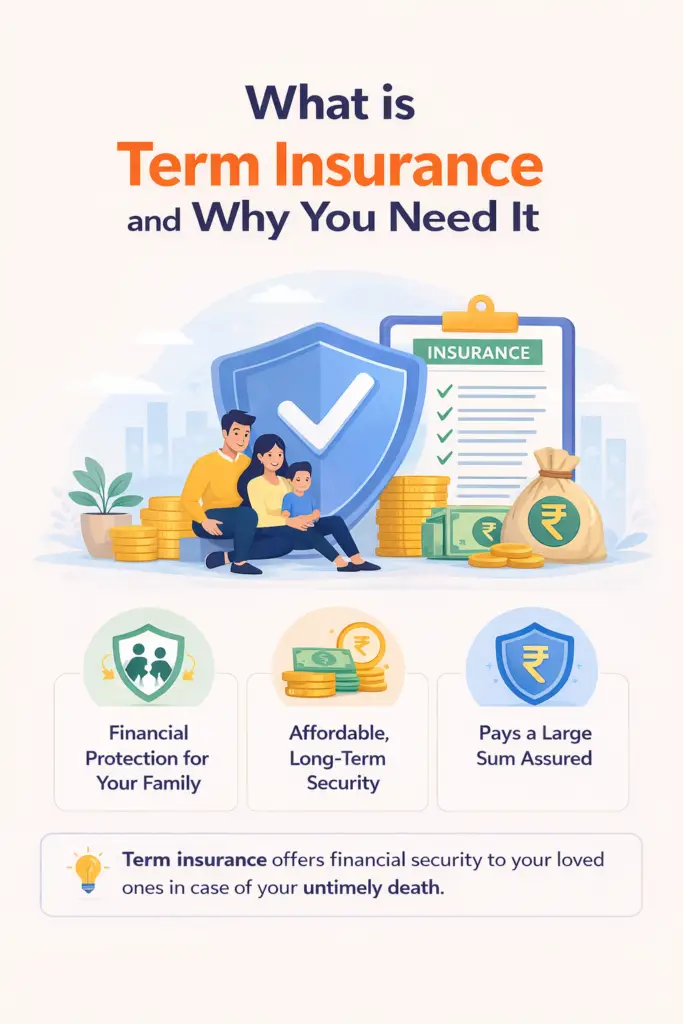
What is Term Insurance and Why You Need It?
Term insurance is the most important yet most overlooked financial product in India. It is also the most misunderstood many people confuse it with traditional life insurance or investment-linked insurance policies. This guide explains exactly what term insurance is, why every earning Indian needs it, how to choose the right policy, and common mistakes to avoid.
🔑 Key Takeaways
- Term insurance is pure life cover pays death benefit to nominees, no savings component.
- A Rs. 1 crore cover costs only Rs. 8,000–12,000 per year for a healthy 30-year-old.
- Freelancers need term insurance more than salaried employees- no employer group cover.
- Claim settlement ratio of 98%+ is the most important factor when choosing an insurer.
- Buy term insurance as early as possible- premiums rise significantly with age.
What is Term Insurance?
Term insurance is a pure life insurance policy that pays a death benefit to your nominees if you die during the policy term. Unlike traditional insurance plans, term insurance has no investment or savings component it is pure protection. This makes it very affordable you get very high coverage at very low premiums.
Term Insurance vs Traditional Insurance
Aspect | Term Insurance |
Coverage | Rs. 1 crore+ |
Annual Premium (30-yr-old) | Rs. 8,000–12,000 |
Coverage per rupee spent | Very high 10–20x more |
Returns on survival | None (in regular term plan) |
Investment component | No pure protection |
Recommended for | Life protection goal |
The comparison is clear: term insurance gives 10x more protection at 4x lower cost. For life protection, term insurance is unbeatable. For investment, use mutual funds.
Why Freelancers Need Term Insurance More Than Salaried Employees
Freelancers have no employer-provided group insurance, no gratuity, no provident fund, and no employer-sponsored benefits. If a freelancer dies unexpectedly, their family has no safety net. Term insurance fills this critical gap. If you have dependents — a spouse, children, or parents term insurance is non-negotiable.
How Much Term Cover Do You Need?
A common rule is to have coverage of 10–15 times your annual income. If you earn Rs. 8 lakh per year, aim for Rs. 80 lakh to Rs. 1.2 crore in coverage. Also factor in:
- Outstanding loans: Home loan, car loan, personal loan
- Children’s education costs Estimated future expense
- Spouse’s financial dependency — years of income replacement needed
- Future family goals — marriage, home purchase for children
- The ideal coverage = outstanding liabilities + 10 years of annual expenses
Your Situation | Recommended Cover |
Annual income Rs. 5 lakh | Rs. 50 lakh – 75 lakh cover |
Annual income Rs. 10 lakh | Rs. 1 crore – 1.5 crore cover |
Annual income Rs. 20 lakh | Rs. 2 crore – 3 crore cover |
Home loan Rs. 50 lakh outstanding | Add Rs. 50 lakh to base cover |
How to Choose a Term Insurance Policy
1. Claim Settlement Ratio
This is the percentage of death claims settled by the insurer. Aim for 98%+ claim settlement ratio. Check the IRDAI annual report for the latest data. This is the single most important factor — a policy is only valuable if the insurer actually pays claims.
2. Solvency Ratio
Solvency ratio shows the insurer’s financial health. IRDAI requires a minimum of 1.5x. Higher is better — indicates the company can meet all its policy obligations even under stress.
3. Policy Term
Cover yourself until at least age 65–70. The most common recommendation is to keep the policy active until your youngest child is financially independent and all major loans are repaid.
4. Premium Amount
Get quotes from 3–5 insurers. For the same cover, premiums can vary by 20–40%. Use online comparison platforms like Policybazaar, Ditto Insurance, or InsuranceDekho.
5. Riders to Consider
- Critical Illness Rider — pays lump sum on diagnosis of 30–60 specified illnesses (cancer, heart attack, etc.)
- Accidental Death Benefit Rider — additional payout on accidental death
- Waiver of Premium Rider — if you are permanently disabled, future premiums are waived
- Income Benefit Rider — pays regular monthly income to nominees instead of lump sum
Online vs Offline Term Insurance: Which to Choose?
Aspect | Online Term Insurance |
Cost | Significantly cheaper (20–40% lower premium) |
Convenience | Apply, compare, buy from home |
Guidance | Requires self-research |
Claim support | Self-service or helpline |
Recommendation | Best for tech-savvy, research-oriented buyers |
For most individuals, online term insurance through comparison platforms like Ditto Insurance, Policybazaar, or direct insurer websites offers the best value.
How to File a Term Insurance Claim- What Nominees Should Know
Educate your nominees on the claim process now:
- Nominee contacts the insurer and notifies them of the insured’s death.
- Nominee submits claim form, death certificate, original policy document, and ID proof.
- Insurer reviews claim — typically takes 30 days for straightforward claims.
- Claim settlement — amount transferred to nominee’s bank account.
Store your policy details, policy number, and insurer contact in a place your nominees can easily access. Consider creating a “financial file” with all policy details.
Common Mistakes to Avoid
- Buying endowment or ULIP “insurance + investment” products — they give poor returns on both counts.
- Underinsuring — taking Rs. 25 lakh cover when you need Rs. 1 crore.
- Delaying term insurance purchase — premiums rise 5–10% every year with age.
- Not disclosing existing health conditions — claims can be rejected for non-disclosure.
- Choosing insurer purely based on lowest premium without checking claim settlement ratio.
- Not informing nominees about the policy — claims can go unfiled if nominees don’t know the policy exists.
Frequently Asked Questions
1. What happens to term insurance if I do not die during the policy term?
In a regular term plan, you receive nothing if you survive the policy term — the premiums are the cost of protection. Return of premium (ROP) term plans return all premiums at maturity but cost significantly more. Experts generally recommend regular term plans and investing the premium difference separately.
2. At what age should I buy term insurance?
The earlier the better. Premiums are lowest when you are young and healthy. A 25-year-old buying Rs. 1 crore cover pays approximately Rs. 6,000–8,000 per year. A 40-year-old pays Rs. 15,000–20,000 for the same cover.
3. Can a freelancer buy term insurance without a regular salary slip?
Yes. For freelancers, insurers accept ITR (Income Tax Return) for 2+ years, bank statements, and a CA certificate as proof of income. Most leading insurers have specific products and underwriting processes for self-employed individuals.
4. Should I buy one large policy or multiple smaller policies?
Multiple policies from different insurers can be beneficial — it diversifies claim risk. Also, as your financial obligations reduce over time (loans paid off, children independent), you can let some policies expire while maintaining necessary base cover.
5. Is term insurance covered under tax deductions?
Yes. Term insurance premiums qualify for deduction under Section 80C (old tax regime, up to Rs. 1.5 lakh). The death benefit received by nominees is completely tax-free under Section 10(10D).
Action Steps — Start Today
Step 1: Calculate your required coverage: 10–15x annual income plus outstanding loans.
Step 2: Get quotes on Policybazaar, Ditto Insurance, or direct insurer websites.
Step 3: Compare claim settlement ratios from IRDAI’s latest annual report.
Step 4: Buy the policy online — do not delay.
Step 5: Inform your nominee about the policy, store policy document safely, and update your ITR nominee details.
Disclaimer: This article is for informational purposes only. Please consult a qualified financial or tax professional for advice specific to your situation.