
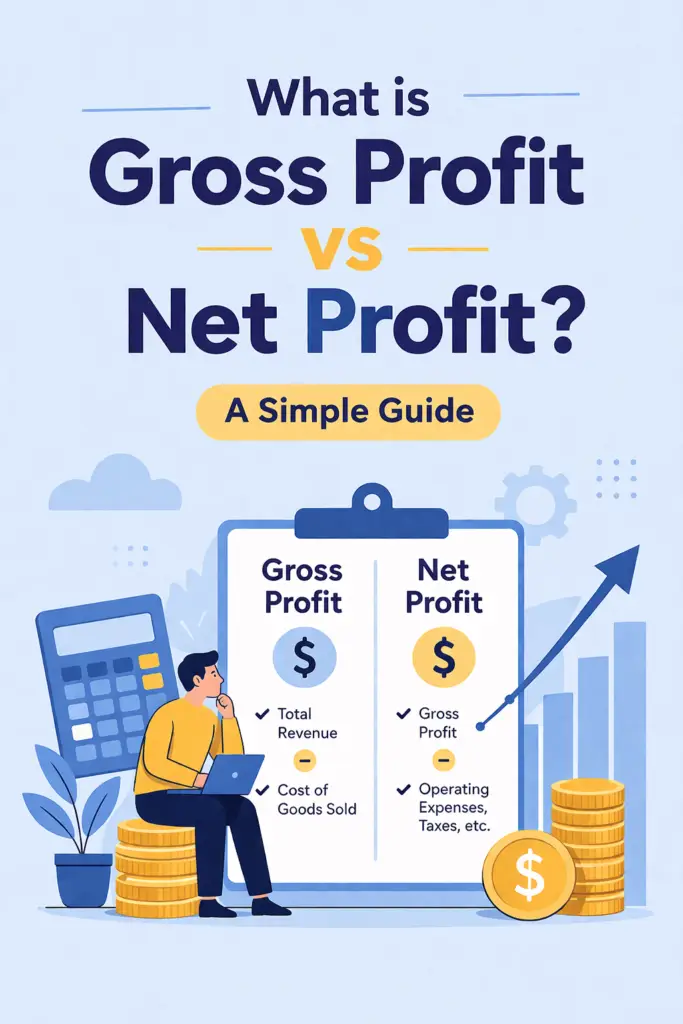
Revenue vs profit is one confusion. But gross profit vs net profit is another layer that trips up many freelancers and small business owners. Understanding the difference between these profitability metrics gives you a much clearer picture of your business health and helps you make better pricing and spending decisions. This guide explains all three profit types simply with practical Indian examples.
 Key Takeaways
- Gross Profit = Revenue minus Direct Costs (subcontractors, project-specific expenses).
- Operating Profit = Gross Profit minus Operating Expenses (indirect overheads).
- Net Profit = Operating Profit minus Taxes and Interest your actual take-home.
- A healthy freelancer net profit margin is 50–70% of revenue.
- Gross margin shows service delivery efficiency; net margin shows overall business efficiency.
The Three Levels of Profit: Overview
Profit Type | Formula |
Gross Profit | Revenue minus Direct Costs |
Operating Profit (EBIT) | Gross Profit minus Operating Expenses |
Net Profit (PAT) | Operating Profit minus Taxes and Interest |
What is Gross Profit?
Gross profit is revenue minus the direct costs of delivering your service or product. For a freelancer, direct costs include: payments to subcontractors or freelancers hired for specific projects, specific tools or software purchased exclusively for a client project, raw materials if you produce physical products.
If a freelancer earns Rs. 1,00,000 from a project and pays Rs. 20,000 to a subcontractor, gross profit is Rs. 80,000. Gross profit margin = Rs. 80,000 ÷ Rs. 1,00,000 = 80%.
What is Operating Profit?
Operating profit (also called EBIT — Earnings Before Interest and Tax) is gross profit minus operating expenses. Operating expenses are indirect costs that exist regardless of individual projects: software subscriptions, internet and utilities, marketing expenses, office rent, equipment depreciation, salaries of support staff. Operating profit shows how efficiently your core business runs before financial costs and taxes.
What is Net Profit?
Net profit is the final bottom line — what you actually take home after all expenses, interest on loans, and income tax are deducted. Net profit = Operating Profit minus Interest minus Taxes. For a freelancer, net profit is essentially your take-home income after all business expenses and tax obligations. It is the most important number.
Gross Profit vs Net Profit — A Complete Annual Example
Line Item | Amount |
Annual Revenue | Rs. 15,00,000 |
Subcontractor Payments (Direct Cost) | – Rs. 3,00,000 |
GROSS PROFIT | Rs. 12,00,000 |
Software & Tools | – Rs. 60,000 |
Internet & Phone | – Rs. 36,000 |
Marketing & Ads | − Rs. 60,000 |
Equipment Depreciation | − Rs. 24,000 |
Total Operating Expenses | − Rs. 1,80,000 |
OPERATING PROFIT | Rs. 10,20,000 |
Income Tax (approx) | − Rs. 1,80,000 |
NET PROFIT | Rs. 8,40,000 |
This means 56 paise of every rupee earned is actual take-home profit an excellent result for a service-based freelancer.
Gross Profit Margin Benchmarks for Indian Freelancers
Business Type | Expected Gross Margin |
Pure service freelancer (no subcontracting) | 85–95% gross margin |
Freelancer with some subcontracted work | 70–85% gross margin |
Agency with significant outsourcing | 50–70% gross margin |
Product business with high COGS | 30–60% gross margin |
Net Profit Margin Benchmarks for Freelancers
Net Margin Range | What It Means |
Above 70% | Exceptional — very lean operations, minimal overhead |
50–70% | Excellent — healthy and sustainable |
30–50% | Good — room for improvement in expense management |
Below 30% | Needs attention — review all expense categories urgently |
Why Both Metrics Matter — And What They Tell You
Gross profit margin tells you how efficient your service delivery is. If your gross margin is too low, you are paying too much for subcontractors or direct costs — consider renegotiating rates or taking more work in-house.
Net profit margin tells you how efficient your overall business is. A high gross margin but low net margin suggests too many overhead expenses — review subscriptions, marketing spend, and fixed costs.
Track both monthly for a complete financial picture.
How to Improve Profit Margins
Improving Gross Profit Margin
- Increase pricing — even 10% rate increase dramatically improves gross margins
- Reduce subcontractor costs by improving in-house capabilities
- Take on higher-value, lower-effort projects
- Package services more strategically to command premium prices
Improving Net Profit Margin
- Audit all software subscriptions — cancel unused ones
- Reduce or eliminate underperforming marketing channels
- Work from home if currently paying unnecessary office rent
- Optimise tax — use Section 44ADA, ELSS, and other legitimate tax reduction strategies
- Invest in tools that increase productivity and reduce hours per project
Revenue vs Profit vs Cash Flow — The Complete Triangle
Understand how these three metrics interact:
Metric | What It Measures | What a Gap Between Them Reveals |
Revenue | Total invoiced to clients | High revenue but low profit = pricing or expense problem |
Profit | Revenue minus all expenses | High profit but negative cash flow = late-paying clients |
Cash Flow | Actual cash received/paid | Cash flow shows real operational health month by month |
A financially healthy business has: growing revenue, improving profit margins, and positive operating cash flow consistently.
Common Mistakes to Avoid
- Tracking only total revenue without looking at margins — high revenue with low margins is a problem.
- Confusing cash received with revenue — calculate profit based on work delivered, cash flow on cash received.
- Ignoring operating expenses — freelancers often forget to account for software, equipment, and marketing costs.
- Not benchmarking margins — compare your margins year-over-year and against industry standards.
- Accepting below-market pricing without tracking its impact on margins.
Frequently Asked Questions
What is a good net profit margin for a freelancer?
A net profit margin of 50–70% is excellent for freelancers since they have relatively low overhead. Below 40% should prompt a review of expenses. Above 70% is exceptional and suggests the business is extremely lean and efficient.
Is gross profit or net profit more important?
Net profit is more important for understanding your actual financial position. However, gross profit is important for evaluating pricing and direct cost efficiency. Track both.
How do I calculate my effective hourly rate using profit metrics?
Calculate: Net Profit ÷ Total Hours Worked = Effective Hourly Rate. If your net profit is Rs. 8 lakh per year and you work 1,500 hours, your effective rate is Rs. 533/hour. This helps you evaluate whether your pricing is adequate for your time investment.
Does Section 44ADA affect how I calculate profit?
Under Section 44ADA for tax purposes, your taxable profit is 50% of gross receipts regardless of actual expenses. However, for business management purposes, always calculate your actual gross and net profit to understand true business performance.
How often should I review my profit margins?
Monthly for a growing business — ideally alongside your P&L statement review. At minimum, quarterly. Annual reviews are too infrequent to catch deteriorating margins before they become a serious problem.
Action Steps — Start Today
Step 1: Calculate your gross profit for this month: Revenue minus direct project costs.
Step 2: List all operating expenses (software, internet, marketing, etc.) for this month.
Step 3: Calculate operating profit and net profit.
Step 4: Compare your net margin to the benchmark table above.
Step 5: Identify the one or two largest expense categories that can be reduced.
Step 6: Set a pricing review reminder increase rates if margins have been declining.
Disclaimer: This article is for informational purposes only. Please consult a qualified financial or tax professional for advice specific to your situation.