
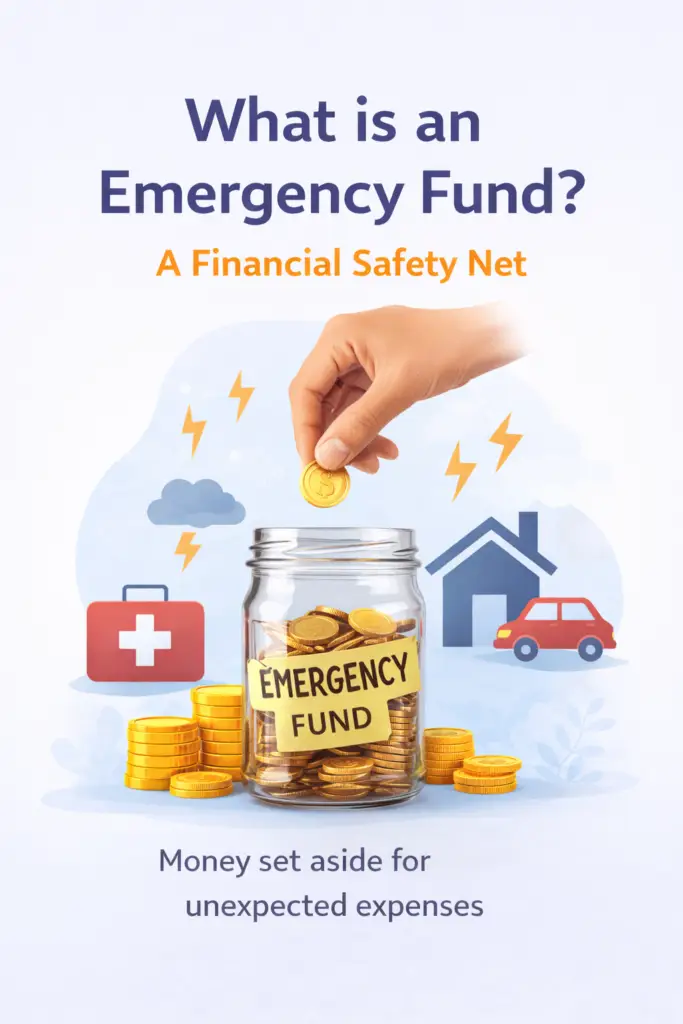
What is an Emergency Fund and How Much Should You Save?
An emergency fund is the foundation of every sound financial plan yet most Indians do not have one. Without an emergency fund, any unexpected expense a medical bill, a job loss, a major repair can derail your finances and push you into debt. This guide explains what an emergency fund is, exactly how much you need, where to keep it, and a practical plan to build one from scratch.
🔑 Key Takeaways
- An emergency fund covers 3–6 months of expenses for salaried individuals; 6–12 months for freelancers.
- Keep your emergency fund in liquid funds or high-yield savings accounts NOT in equity.
- Build emergency fund before starting aggressive investments.
- Separate account for emergency fund prevents accidental spending.
- Replenish your emergency fund immediately after using it.
What is an Emergency Fund?
An emergency fund is a dedicated pool of money set aside specifically for unexpected financial emergencies. It is not for vacations, gadget upgrades, or planned expenses it is strictly for genuine emergencies that you cannot predict: sudden job loss, medical emergency, urgent home or vehicle repair, or any other unexpected financial shock.
Why Do You Need an Emergency Fund?
Without an emergency fund, you have two options when an emergency strikes: withdraw from investments (losing compounding growth), or take a personal loan (paying interest). Both options are costly. An emergency fund acts as a financial buffer that protects your investments and keeps your debt-free during tough times.
Situation | Outcome |
No emergency fund + medical emergency | Break FD early (penalty + lost interest) or take personal loan at 14–20% interest |
No emergency fund + job loss | Stop SIP, sell investments at possible loss, or borrow from family |
Emergency fund available | Use fund, handle emergency calmly, continue investments uninterrupted |
How Much Should You Save in an Emergency Fund?
The general rule is to save 3 to 6 months of your monthly expenses in your emergency fund. For salaried individuals with stable income, 3 months is sufficient. For freelancers and self-employed professionals with irregular income, 6 to 12 months is recommended. Calculate your monthly expenses including rent, food, utilities, loan EMIs, insurance premiums, and other necessities.
Your Situation | Recommended Emergency Fund Size |
Salaried employee, dual income household | 3 months of expenses |
Salaried employee, single income | 4–6 months of expenses |
Freelancer with steady, recurring clients | 6 months of expenses |
Freelancer with variable / project-based income | 9–12 months of expenses |
Sole breadwinner with dependents | 6–9 months of expenses |
Emergency Fund Calculator- A Quick Reference
To find your target emergency fund amount:
- Calculate your monthly essential expenses (rent + food + utilities + EMIs + insurance).
- Exclude discretionary spending (dining out, entertainment, subscriptions).
- Multiply by your required months (3, 6, or 12 based on table above).
- That is your emergency fund target.
Example: A freelancer spends Rs. 40,000/month on essentials. Target = Rs. 40,000 × 9 = Rs. 3,60,000.
Emergency Fund for Freelancers- Special Considerations
As a freelancer, your income is irregular — some months are great, others are slow. This makes an emergency fund even more critical. A 6-month emergency fund for a freelancer spending Rs. 40,000 per month means you need Rs. 2,40,000 readily accessible. This allows you to handle a slow business period without financial panic or taking on debt.
Freelancers should also consider a “business emergency fund” separate from a personal emergency fund — to cover unexpected business expenses like equipment failure, urgent outsourcing, or software subscription costs.
Where Should You Keep Your Emergency Fund?
Your emergency fund must be liquid — accessible within 24 hours. Do not invest it in equity mutual funds or long-term instruments. Best options in India:
Where to Keep It | Pros |
High-yield savings account | 3.5–7% interest, instant access, zero risk |
Liquid mutual funds | 5–7% returns, accessible in 24 hours, very low risk |
Overnight mutual funds | 5–6% returns, next-day access, lowest risk |
Short-term FDs with sweep-in | 6.5–7.5% interest, can be broken anytime without major penalty |
Money Market Funds | 5–7% returns, highly liquid, low risk |
Do NOT keep emergency fund in: Equity mutual funds (can fall 40% when you need it most), ELSS (locked-in for 3 years), real estate (completely illiquid), or long-term FDs without premature withdrawal facility.
How to Build an Emergency Fund- Step by Step
- Open a separate savings account specifically for your emergency fund — keeping it separate prevents accidental spending.
- Calculate your target amount — monthly essential expenses × required months.
- Start with a mini emergency fund goal of Rs. 50,000 immediately.
- Set a monthly savings target — even Rs. 3,000 per month adds Rs. 36,000 in a year.
- Automate a transfer to this account on the day your income arrives.
- Increase contributions during good months to reach your target faster.
- Move from savings account to liquid fund once balance crosses Rs. 1 lakh for better returns.
- Reach your full target before starting aggressive equity investments.
Emergency Fund vs Rainy Day Fund- What is the Difference?
Many financial experts distinguish between these two:
Aspect | Emergency Fund |
Purpose | Genuine emergencies: job loss, medical crisis, major repair |
Size | 3–12 months of expenses |
Where to keep | Liquid fund or high-yield savings |
When to use | Only genuine emergencies |
Having both funds ensures you are protected against both true emergencies and irregular predictable expenses without disrupting your investment SIPs.
What Qualifies as a Genuine Emergency?
To prevent “emergency fund leakage”, be strict about what counts as an emergency:
- Genuine emergencies: Job loss, medical bill, essential vehicle repair, urgent home repair (roof, plumbing)
- Not emergencies: Vacation, gadget upgrade, festive shopping, sale discounts, eating out more frequently
Common Mistakes to Avoid
- Keeping emergency fund in equity mutual funds markets crash exactly when emergencies happen.
- Using emergency fund for planned expenses it dilutes the purpose.
- Not replenishing emergency fund after using it.
- Having no separate account mixing emergency fund with regular savings leads to accidental spending.
- Waiting to build emergency fund until income “improves” start with Rs. 500/month from today.
- Not accounting for EMIs in monthly expense calculation.
Frequently Asked Questions
1. Should I pay off debt or build an emergency fund first?
Build a small emergency fund of 1 month’s expenses first, then aggressively pay off high-interest debt (credit cards, personal loans), then build the full emergency fund, then start investing.
2. Can I invest my emergency fund in equity mutual funds?
No. Emergency funds must be in liquid, low-risk instruments. Equity markets can fall 30–50% when you need the money most during a crisis. Keep it in liquid funds or a high-yield savings account.
3. What if I have to use my emergency fund?
Use it guilt-free that is exactly what it is for. After the emergency is resolved, immediately start rebuilding it. Pause non-essential discretionary expenses temporarily and redirect that money back to the emergency fund until it is fully replenished.
4. Should my emergency fund account earn the highest possible return?
Return is secondary to liquidity and safety for emergency funds. A liquid fund earning 6% is better than an FD earning 7.5% if the FD has a 6-month lock-in. Prioritise: Safety first, Liquidity second, Return third.
5. How is emergency fund different from savings?
Regular savings can be used for any purpose travel, gadgets, or investments. Emergency fund is strictly ring-fenced for genuine emergencies only. The mental and physical separation (separate account) is critical.
Action Steps- Start Today
Step 1: Calculate your monthly essential expenses today.
Step 2: Multiply by 6 that is your emergency fund target.
Step 3: Open a separate savings account labelled “Emergency Fund”.
Step 4: Transfer Rs. 2,000–5,000 to it today as the first contribution.
Step 5: Set up a monthly auto-transfer to this account on your salary date.
Step 6: Once you reach Rs. 1 lakh, move to a liquid mutual fund for better returns.
Disclaimer: This article is for informational purposes only. Please consult a qualified financial or tax professional for advice specific to your situation.