
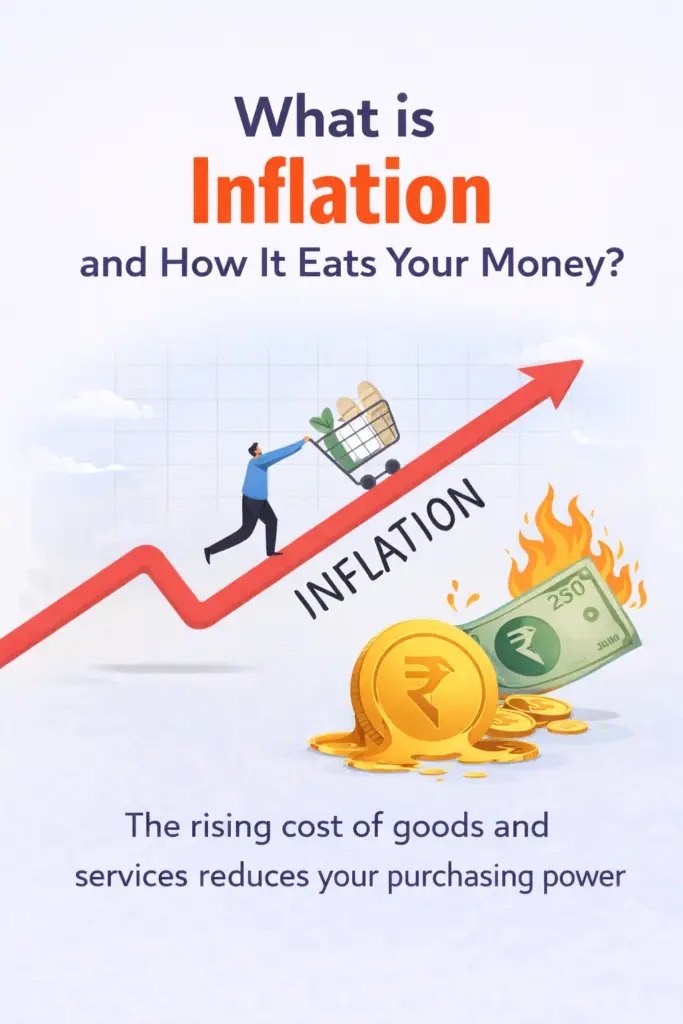
Inflation is silently eroding your money right now even if you are not aware of it. Every year, the prices of goods and services rise, which means the same amount of money buys less than it did before. Understanding inflation is critical to making smart financial decisions. This guide explains what inflation is, how it works in India, and most importantly how to protect your money from it.
 Key Takeaways
- Inflation is the rate at which prices rise, reducing purchasing power over time.
- India’s CPI inflation has averaged 5–7% over the past decade.
- Money kept in cash loses purchasing power every year, investing is essential.
- Equity mutual funds historically outpace inflation at 12–15% returns vs 5–7% inflation.
- The “real return” is your investment return minus inflation this is what actually matters.
What is Inflation?
Inflation is the rate at which the general price level of goods and services increases over time. It is measured in India primarily through the Consumer Price Index (CPI) — a basket of commonly purchased goods and services tracked monthly by the government.
Types of Inflation in India
Type | What Causes It |
Demand-pull inflation | Caused by high consumer demand exceeding supply too much money chasing too few goods |
Cost-push inflation | Caused by rising production costs (raw materials, energy) pushing prices up |
Structural inflation | India-specific: supply chain inefficiencies, poor logistics common in food sector |
Imported inflation | Rising global commodity prices (oil, metals) imported into domestic prices |
Core inflation | Inflation excluding volatile food and fuel prices shows underlying trend |
How Inflation Affects Your Money
If inflation is 6% per year and your savings account earns 4% interest, your real return is negative 2%. Your money is actually losing purchasing power.
Scenario | Inflation Reality |
What Rs. 100 buys today | Rs. 100 worth of goods |
After 10 years at 6% inflation | Rs. 179 needed to buy the same |
Purchasing power loss | — |
Rs. 10 lakh kept in a zero-interest account for 10 years at 6% inflation has the purchasing power of only Rs. 5.58 lakh. Your money effectively halved.
The Real Return on Investments
Real Return = Nominal Return minus Inflation Rate. This is the return that actually matters:
Investment | Nominal Return |
Savings account | 3.5% |
Fixed Deposit | 7% |
PPF | 7.1% |
Equity Mutual Funds | 12–15% |
Index Funds (Nifty 50) | 11–13% |
India’s Inflation Rate: Historical Context
India’s CPI inflation has averaged approximately 5–7% over the past decade. This means your investments must return more than 5–7% annually just to maintain purchasing power. Fixed deposits at 6–7% barely keep pace with inflation. Equity investments historically return 12–15% — well above inflation.
India’s inflation is influenced by: monsoon performance (food prices), global crude oil prices, RBI monetary policy, government spending, and currency movements.
How the RBI Controls Inflation
The Reserve Bank of India’s primary mandate is price stability — maintaining CPI inflation in the 4% ±2% band (2–6%). The RBI uses the repo rate (the interest rate at which it lends to banks) as its primary tool. When inflation rises, RBI raises rates — making loans expensive and reducing spending. When inflation falls, RBI cuts rates to stimulate growth.
How Inflation Affects Different Asset Classes
Asset Class | Inflation Protection Ability |
Cash / Savings | Loses purchasing power at inflation rate — worst option for long-term storage |
Fixed Deposits | Barely beats inflation at current rates — good only for short-term safety |
Gold | Strong long-term inflation hedge — averages 8–10% in India over decades |
Real Estate | Generally appreciates above inflation long term in urban India |
Equity Mutual Funds | Best inflation-beating asset class historically — 12–15% returns |
Index Funds | Matches market returns — strong inflation beater over 5+ year horizon |
How Inflation Affects Your Salary and Income
Your salary or freelance rate needs to increase at least as fast as inflation to maintain your real income. If you earn Rs. 10 lakh this year and inflation is 6%, you need to earn Rs. 10.6 lakh next year just to maintain the same purchasing power. This is why annual salary hikes below 6% are effectively pay cuts in real terms.
For freelancers: review and increase your rates annually by at least the rate of inflation. Do not let your rates stagnate for years — your effective income is declining in real terms.
How to Protect Your Money from Inflation
- Invest in equity — the stock market historically returns 12–15% versus 6% inflation.
- Include gold in portfolio — 5–10% allocation as inflation hedge.
- Invest in real assets — real estate appreciates with inflation.
- Avoid keeping large amounts in cash or low-yield savings.
- Increase income regularly — skills, freelance rates, salary hikes.
- Buy inflation-indexed assets — gold ETFs, international diversification.
Common Mistakes to Avoid
- Keeping large sums in savings accounts for years — silent wealth destruction.
- Thinking FD is “safe” — at 7% FD return with 6% inflation, real safety is minimal.
- Not increasing freelance rates annually — stagnant rates mean declining real income.
- Investing all money in fixed income — no inflation protection over long term.
- Ignoring real return — comparing only nominal returns without accounting for inflation.
Frequently Asked Questions
1. Is some inflation good?
Yes. Moderate inflation of 2–4% is considered healthy as it encourages spending and investment rather than hoarding cash. Deflation (falling prices) is actually more dangerous as it kills economic activity.
2. What is hyperinflation?
Hyperinflation is extremely rapid inflation — like 50% or more per month. It destroys the value of money rapidly. India has never experienced hyperinflation in modern times.
3. How does inflation affect my loan EMIs?
Fixed-rate loan EMIs are not directly affected by inflation — you pay the same amount. However, in real terms, inflation actually helps borrowers — you are repaying debt with future money that is worth less than when you borrowed. This is why owning real assets (property) financed by a loan can be a good inflation strategy over time.
4. Should I buy gold to protect against inflation?
Gold is a partial inflation hedge — historically it maintains purchasing power over the very long term (20–30 years). However, over shorter periods (5–10 years), gold can underperform. A 5–10% allocation to gold in your portfolio provides diversification benefits without over-relying on it as an inflation hedge.
Action Steps — Start Today
Step 1: Calculate your “real return” — your investment return minus current inflation rate.
Step 2: Move any large savings account balances into liquid funds earning 5–7%.
Step 3: Review your freelance rates — have you increased them by at least 6% this year?
Step 4: Start or increase SIP in equity mutual funds to build inflation-beating wealth.
Step 5: Use the Finolpha Inflation Impact Calculator to visualise how inflation affects your savings.
Disclaimer: This article is for informational purposes only. Please consult a qualified financial or tax professional for advice specific to your situation.