
What is an Index Fund? Should You Invest in One?
Index funds have quietly become one of the most popular investment choices globally — and are now gaining significant traction in India. Loved by legendary investor Warren Buffett and recommended by most financial experts for beginners, index funds deserve your attention. This complete guide explains what index funds are, how they work, and whether they belong in your portfolio.
🔑 Key Takeaways
- An index fund passively tracks a market index like Nifty 50.
- Expense ratios can be as low as 0.1% vs 1–2% for active funds.
- Over 80% of actively managed funds fail to beat their benchmark over 10 years.
- Nifty 50 index funds have never given negative returns over any 10-year period historically.
- Index funds are the ideal starting point for beginner investors in India.
What is an Index Fund?
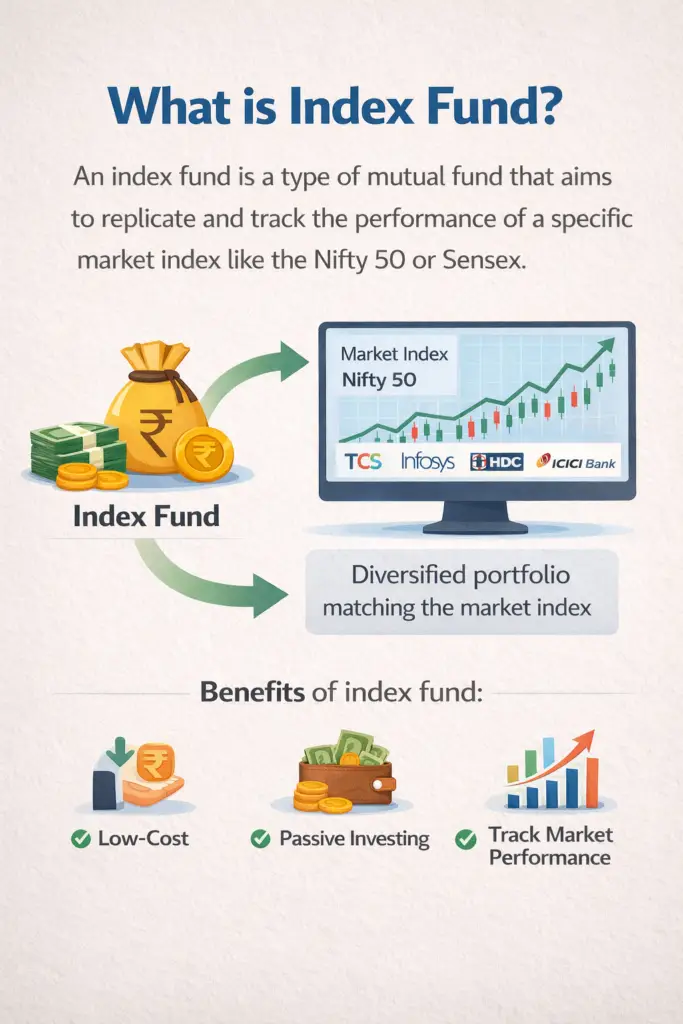
An index fund is a type of mutual fund that passively tracks a market index — like the Nifty 50 or Sensex rather than actively trying to beat the market. The fund simply buys all (or most) of the stocks in the index in the same proportion as the index itself.
For example, a Nifty 50 Index Fund holds all 50 stocks of the Nifty 50 index in the exact same weightage. When the Nifty 50 goes up by 1%, the index fund goes up by approximately 1% too. When it falls, the fund falls similarly.
How is an Index Fund Different from an Active Mutual Fund?
Index Fund | Active Mutual Fund |
Passively tracks an index | Fund manager actively picks stocks |
No fund manager decisions needed | Depends on fund manager’s skill |
Very low expense ratio (0.1–0.5%) | Higher expense ratio (1–2%) |
Returns mirror the index | Aims to beat the index |
Lower risk of underperformance | Risk of underperforming the index |
Ideal for passive, long-term investors | Better if fund manager has track record |
Transparent — you know what you own | Holdings known only monthly |
Popular Indices Tracked by Index Funds in India
Index | What It Represents |
Nifty 50 | Top 50 companies on NSE by market cap |
Sensex (BSE 30) | Top 30 companies on BSE by market cap |
Nifty Next 50 | Next 50 largest companies after Nifty 50 |
Nifty Midcap 150 | 150 mid-sized companies |
Nifty Smallcap 250 | 250 smaller companies |
Nifty IT | Top IT sector companies |
Nifty Bank | Top banking sector companies |
S&P 500 (US) | Top 500 US companies — via international index funds |
Why Are Index Funds Popular?
The core argument for index funds comes from data: a large majority of actively managed funds fail to consistently beat their benchmark index over the long term, especially after accounting for their higher expense ratios. If most active funds cannot beat the index, why not just own the index at a fraction of the cost?
Benefits of Index Funds
- Low cost — expense ratios as low as 0.1% versus 1–2% for active funds
- Transparency — you always know exactly what you own
- Diversification — instant exposure to 50+ companies with one fund
- Consistent market returns — no underperformance risk from bad fund manager decisions
- Simple to understand and monitor
- No fund manager risk — the index never retires or switches funds
- Ideal for SIP-based long-term wealth creation
The Impact of Low Expense Ratio, A Real Numbers Example
A 1% difference in expense ratio may seem small, but it has a massive impact over decades. Consider Rs. 5,000 monthly SIP for 20 years at 12% returns:
Fund Type | Expense Ratio |
Index Fund | 0.2% |
Active Fund | 1.5% |
Difference | 1.3% |
That Rs. 5.6 lakh difference is purely from cost savings — no market timing, no fund manager, just lower fees compounding over time.
Index Fund vs ETF? What is the Difference?
Both index funds and ETFs (Exchange Traded Funds) track market indices. Here are the key differences:
Index Fund | ETF |
Bought/sold at daily NAV | Traded on stock exchange like shares |
No demat account needed | Requires demat account |
Auto-debit SIP available | Manual purchase each time (no auto-SIP on most platforms) |
Slightly higher tracking error | Lower tracking error generally |
More convenient for beginners | Preferred by advanced investors |
For most retail Indian investors, index mutual funds are more practical than ETFs due to easier SIP setup and no demat account requirement.
How Are Index Funds Rebalanced?
Index funds are rebalanced when the underlying index is rebalanced. For example, Nifty 50 is reviewed semi-annually by NSE. When companies are added or removed from the index, the index fund automatically adjusts its portfolio to mirror the change. This process is automated — no fund manager decisions are involved.
Best Index Funds in India to Consider
Some well-established index funds in India (for research purposes — always verify current performance):
- UTI Nifty 50 Index Fund — one of the oldest and most popular
- HDFC Index Fund Nifty 50 Plan
- SBI Nifty Index Fund
- Nippon India Index Fund Nifty 50
- Motilal Oswal Nifty 50 Index Fund
- Motilal Oswal Nifty Next 50 Index Fund — for slightly higher growth potential
- UTI Nifty Next 50 Index Fund
When comparing index funds, look for: lowest expense ratio, lowest tracking error (how closely the fund mirrors the index), and AUM size (larger AUM generally means better liquidity).
International Index Funds — Diversifying Beyond India
India-based investors can now invest in international indices through Fund of Funds (FoFs). This gives you exposure to US tech giants (Apple, Microsoft, Google, Amazon) through Nifty 50-equivalent US index funds.
- Motilal Oswal Nasdaq 100 FoF — invests in top 100 US tech companies
- Mirae Asset S&P 500 Top 50 ETF FoF — tracks top 50 US companies
- Edelweiss Greater China Equity Off Shore Fund — exposure to Chinese markets
Keeping 10–20% of your portfolio in international index funds adds geographic diversification and exposure to global growth trends.
Should You Invest in an Index Fund?
Index funds are ideal for you if:
- You are a beginner investor with no time or knowledge to research stocks or funds
- You want low-cost, hassle-free long-term wealth creation
- You have a 5+ year investment horizon
- You believe in long-term India growth story without stock-picking
- You want to match, not necessarily beat, market returns
Index funds may not be ideal if:
- You want the possibility of beating the market (though most active funds don’t achieve this)
- You are investing for a short-term goal (less than 3 years)
- You want exposure to specific sectors or themes
Common Mistakes to Avoid
- Choosing an index fund with high tracking error — even 0.5% excess can compound negatively.
- Investing in sector index funds as a beginner — broad market index funds are safer starting points.
- Switching index funds frequently — this defeats the purpose of passive investing.
- Comparing index fund returns with active fund returns over bull markets only — compare across market cycles.
- Not reinvesting dividends in dividend option index funds — choose growth option for compounding.
Frequently Asked Questions
Is a Nifty 50 index fund risky?
Like all equity investments, Nifty 50 index funds carry short-term market risk. However, over 10+ year periods, the Nifty 50 has never given negative returns historically. Long-term investors with patience benefit greatly.
What is tracking error in index funds?
Tracking error measures how closely the fund follows the index. A lower tracking error means the fund closely mirrors the index performance. When comparing index funds, always choose the one with the lowest tracking error.
Can index funds go to zero?
For an index fund to go to zero, all 50 companies in the Nifty 50 would have to go bankrupt simultaneously — this is virtually impossible. Index funds carry market risk but not zero-risk. Historically, the Nifty 50 has always recovered from every market crash.
Should I choose Nifty 50 or Nifty Next 50 index fund?
For beginners, Nifty 50 is the safest starting point — the largest, most liquid companies in India. Nifty Next 50 offers higher growth potential but with more volatility. A combination of 70% Nifty 50 + 30% Nifty Next 50 is a popular strategy for slightly enhanced returns with managed risk.
What is the ideal time to start investing in an index fund?
The best time to invest is now. Index funds work through market cycles — when markets are high you get fewer units, when they fall you get more units at lower prices. Time in the market beats timing the market. Start a SIP today.
Action Steps — Start Today
- Step 1: Open a mutual fund account on Groww, Zerodha Coin, or Paytm Money.
- Step 2: Start with a Nifty 50 index fund SIP of any amount from Rs. 500.
- Step 3: Compare 2–3 Nifty 50 funds on expense ratio and tracking error — choose the lowest.
- Step 4: Set SIP to auto-debit and forget for at least 5 years.
- Step 5: Review annually — if the fund’s tracking error is consistently high, consider switching to a lower-cost option.
Disclaimer: This article is for informational purposes only. Please consult a qualified financial or tax professional for advice specific to your situation.